
Leonardo da Vinci Museum leadership repeatedly said they would not seek taxpayer funds for the museum, yet they have been active over the last year asking for over $2,000,000 across requests and restricted funds. Less than two months after Pueblo City Council rejected an $885,000 funding request from the voter-approved Half-Cent Economic Development Fund, the Da Vinci Museum is back seeking public dollars through a different source.
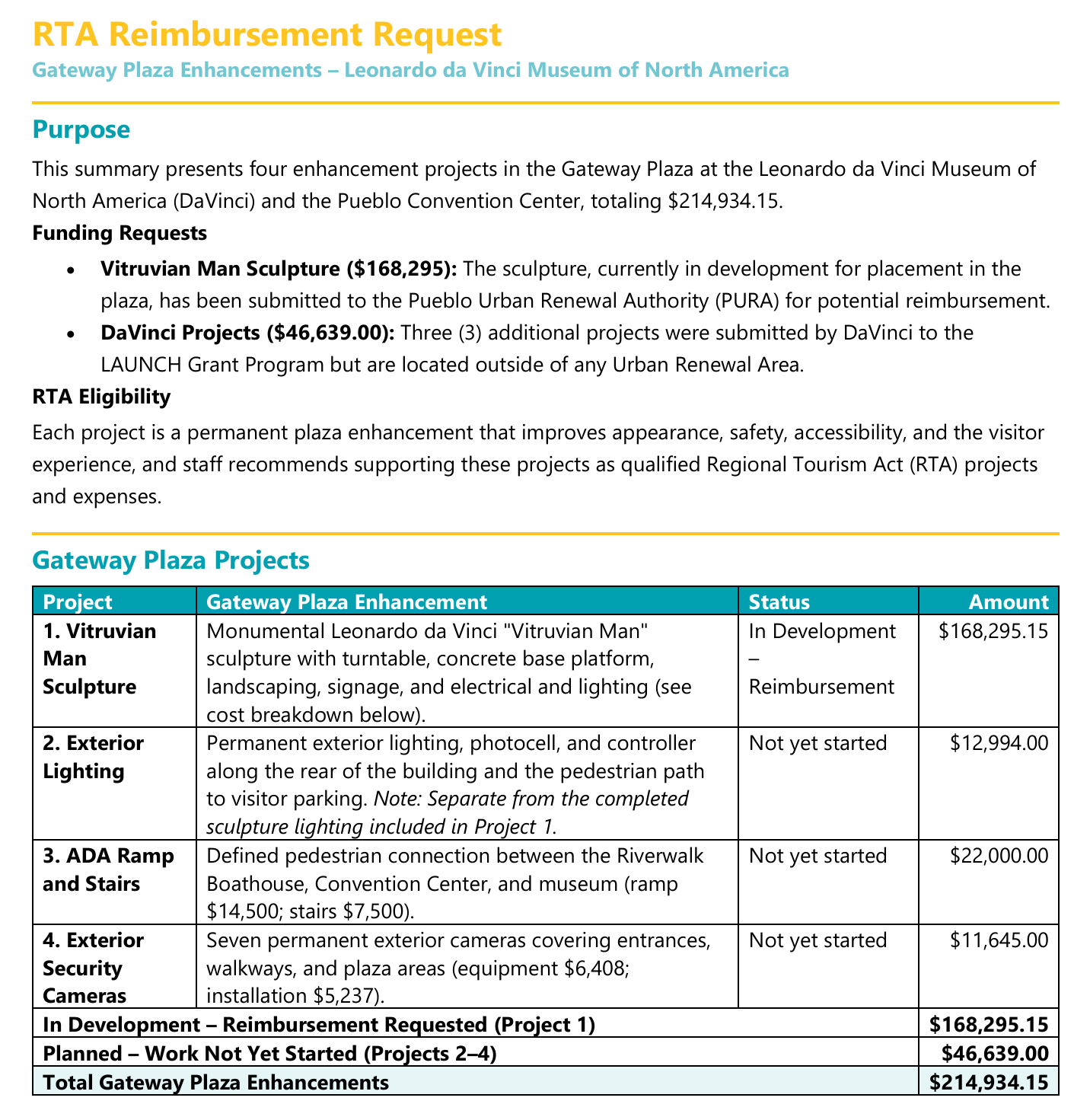
This time they are requesting $214,934.15.
On November 3, the Pueblo Urban Renewal Authority (PURA) will consider whether Regional Tourism Act (RTA) funds should be used to reimburse or finance four projects connected to the museum and Gateway Plaza, including a $168,295 sculpture that the museum has already publicly identified as being funded by a private donor honoring his late wife.
A New Funding Path After Previous Ones Failed
Earlier this year, the museum originally sought approximately $1.8 million from Pueblo’s Half-Cent fund. About half of that request involved employment incentives. The remaining $885,000 focused on improvements such as the museum café, gift shop, exhibits, security, and site enhancements. City Council ultimately rejected the proposal 5-2.
Now some of those same types of improvements have resurfaced under a different funding mechanism.
The current RTA request includes:
Vitruvian Man sculpture and installation: $168,295.15
Exterior lighting: $12,994
ADA ramp and stairs: $22,000
Exterior security cameras: $11,645
Total: $214,934.15
According to PURA’s report, the sculpture would be reimbursed after the fact because much of the work has already been completed and paid for. The remaining projects would be recognized as eligible for future reimbursement.
Notably, several of the smaller projects had also been submitted through PURA’s LAUNCH grant program before being redirected to RTA funding because the museum is not located in an urban renewal district.
As we follow the money on this latest request keep this core question in mind:
If these projects were always eligible for RTA funding, why spend months pursuing other public funding sources first?
The Sculpture That Was Already Paid For
The most difficult question centers on the sculpture. The museum announced during its grand opening that local businessman Tom Welte was funding the Vitruvian Man sculpture in memory of his wife, Nanci. The museum has publicly recognized the Welte family as sponsors of the project.
What is harder to understand is why taxpayers are now being asked to reimburse the same $168,295 project. If the sculpture was privately funded, what exactly would public money be supporting and how does Welte and his family receive the honor he paid for?
If donor funds were restricted specifically for the sculpture, reimbursement could violate Colorado charitable-fund law and nonprofit accounting standards that establish requirements for respecting donor intent. When a museum seeks taxpayer dollars to cover expenses already paid for by a private donor, it appears they are doing so to free up money without the same restrictions. That’s a problem.
The donor, sculptor and taxpayers deserve transparency before PURA reimburses a project already presented as privately financed.
Does the Museum Qualify for RTA Funds? What the State Approved Shows the Answer.
The museum has repeatedly argued that its location within Gateway Plaza on the Riverwalk and the broader RTA project area makes these improvements automatically eligible for RTA funding. But occupancy and eligibility are not necessarily the same thing.
When the Colorado Economic Development Commission (EDC) approved the museum as a replacement tenant in the former PBR University space, the state approved the change in use. At the same time, the commission expressly excluded museum tenant improvements from RTA funding.
Later when Council was considering the museum’s Half-Cent funding request, they asked the museum why they hadn’t applied for state funds if they were an RTA project. The museum didn’t have an answer. I do!
The state approved the museum moving into the building. It did not approve using RTA funds for future museum construction, enhancements, or expansion projects. That’s pretty specific approval and shows the state wasn’t approving funding for the museum.
Yet the current recommendation relies heavily on the fact that the improvements are located within Gateway Plaza without providing the authorization that specifically identifies a museum sculpture, security cameras, café improvements, or future patio construction as eligible and state approved RTA expenses.
Gateway Plaza Improvement or Museum Improvement?
PURA’s recommendation suggests these projects permanently enhance Gateway Plaza. Yes and no. An ADA connection serving multiple facilities arguably benefits the broader public space. A museum-specific ramp, sculpture and security cameras is less clear. The Vitruvian Man sculpture exists because the museum exists. It was commissioned by the museum, promoted by the museum, and intended to enhance the museum experience.
Without the museum, there would likely be no reason for the sculpture to occupy that location. Therefore, it’s harder to justify it as something that universally improves visitor experience the way the entire RTA project did.
Colorado’s tourism funding program was designed to support specific state-approved tourism projects, not function as a general-purpose grant fund for every future improvement proposed within a project boundary.
“Are we funding projects that qualify, or redefining qualifications to fund preferred projects?
This is becoming a concerning trend with the RTA, PURA and the City. When the original RTA project couldn’t meet the primary jobs requirement in the Half-Cent Fund, Council just changed the definition of a primary job.
Now, PURA is stretching the definition of the approved RTA project and its improvements to fit a museum’s expenses after Council rejected a similar ask for not conforming with the funding source.
Unfinished Commitments Remain in the RTA Project
There is another issue lingering beneath the discussion. Pueblo’s original RTA vision extended beyond Gateway Plaza and the Convention Center. It also included an aquatic center and water park that have yet to materialize.
Meanwhile, PURA continues carrying more than $14 million in obligations related to prior RTA infrastructure investments. They have yet to answer how they plan to repay this debt to the Half-Cent Fund only offering the Convention Center that houses the museum as collateral.
Every dollar spent today is a dollar unavailable tomorrow and the public doesn’t have a clear picture of what’s left and how this ask will affect the projects still pending.
What PURA Hasn’t Shown
The recommendation asks the board to accept these costs as eligible RTA expenditures without the justification and documented authority. This puts the PURA board in a compromised position that could result in approval of ineligible expenses. It’s also worth noting that the museum pays PURA over $142,000 every year in rent.
Missing from the public record are:
Documentation tying each project to original RTA authorization.
An explanation of the state’s exclusion of museum tenant improvements.
Records reconciling the privately funded sculpture with the proposed reimbursement.
A detailed accounting of remaining RTA funds and outstanding obligations.
Clarification of procurement, reimbursement, and approval requirements.
Clear responsibility for future maintenance and replacement costs.
Are these truly improvements authorized under Pueblo’s original Regional Tourism Act project, or are they being treated as eligible simply because the museum occupies a building that was funded through that project?
Approval should follow proof, not assumptions. Until eligibility is clearly established and the state EDC confirms these expenditures align with the original project approval, PURA should reject the request.
Share your concerns: Attend the public forum on November 3 at 2 pm at the Convention Center or email info@puebloura.org.

About this review: This is an independent examination of publicly available records related to the museum’s public funding request. The reimbursement request is scheduled for PURA’s November 3, 2026 work session and has not been reported here as approved. The donor agreement, complete payment records, current RTA balances and any unpublished eligibility opinions were not available for verification. The analysis will be updated as additional documentation becomes available.
Public sources and documentation
PURA November 3, 2026 Work Session Packet, pages 251–252. Proposed reimbursement and eligibility assertions.
Colorado Economic Development Commission Minutes, February 20, 2025. Museum change-of-use approval and tenant-improvement limitation.
Da Vinci Museum Grand Opening Announcement, May 8, 2026. Identifies the sculpture’s private benefactor and memorial purpose.
Colorado Revised Statutes §24-46-303. Definitions of eligible RTA costs and improvements.
Pueblo Ordinance No. 8870 and Original RTA Financing Documents. Original project scope and financing.
Colorado Regional Tourism Act Program. State program purpose and requirements.
Colorado Revised Statutes §15-1-1106. Modification of donor restrictions.
So, What Exactly Is Pueblo's RTA in 5 Minutes

Think of the Regional Tourism Act (RTA) as a financing arrangement the state created to help communities build major tourism attractions.
Great article, as always. How could they even build this without having any ADA accommodations in place? they want to do a sculpture without that first? honestly if they are to get any funding, they should have that as #1, then lighting second. Those are safety measures. That does not mean I agree with any of the sources of funding thats purely because of the nature of what it would go towards. It's still not safe when you try an exit, their entrance and exit is a fire hazard, doesnt make sense to me for anyone thats been there but what do I know.
Thanks for all the articles you post and keeping us up to date!
I’d like to clarify the distinction between the donation and the dedication. Tom Welte made a charitable donation to the museum, rather than a sponsorship of the sculpture. The sculpture’s dedication honors the memory of his late wife, Nanci.
The museum also already has an ADA-accessible entrance. The proposed ramp and stairs were intended to provide an additional pedestrian connection between the museum sidewalk and the new Boathouse construction.
Thank you for the opportunity to clarify these points.